
Our São Tomé & Príncipe itinerary begins in São Tomé
We landed on São Tomé and spent our first night on the island.
The next morning, one of our first stops was the National Museum. It immediately gave the trip more historical weight, taking us through the islands’ colonial past, independence and the story of a bloody uprising from the country’s more recent history.
São Tomé & Príncipe may look like a tropical island escape at first glance, but its history is never very far away.
We did not stay long at first. We had planned to spend a few days on Príncipe before returning to the main island for the rest of the trip.
That short detour turned out to be one of the strongest contrasts of the entire journey.
Our route across the islands
We flew to Príncipe for a few days before returning to the main island. On São Tomé we kept one base in the north-east throughout, which meant driving the east coast up and down twice.
- 1 São Tomé First night and the National MuseumArrival
- 2 Príncipe Quinta Santa Rita, Banana Beach and Burra BeachIsland
- 3 Roça Sundy Plantation history and cacaoCulture
- 4 Porto Real The old hospital, with ZezéCulture
- 5 São Tomé city The cathedral and the marketBase
- 6 Roça Água Izé A plantation that became a townCulture
- 7 Boca do Inferno Waves against black volcanic rockNature
- 8 Pico Cão Grande A tough jungle hike to the baseHike
- 9 Ilhéu das Rolas One foot in each hemisphereIsland
- 10 Surf lesson Mostly flat on the boardLast day
Príncipe: small, quiet and remarkably cared for
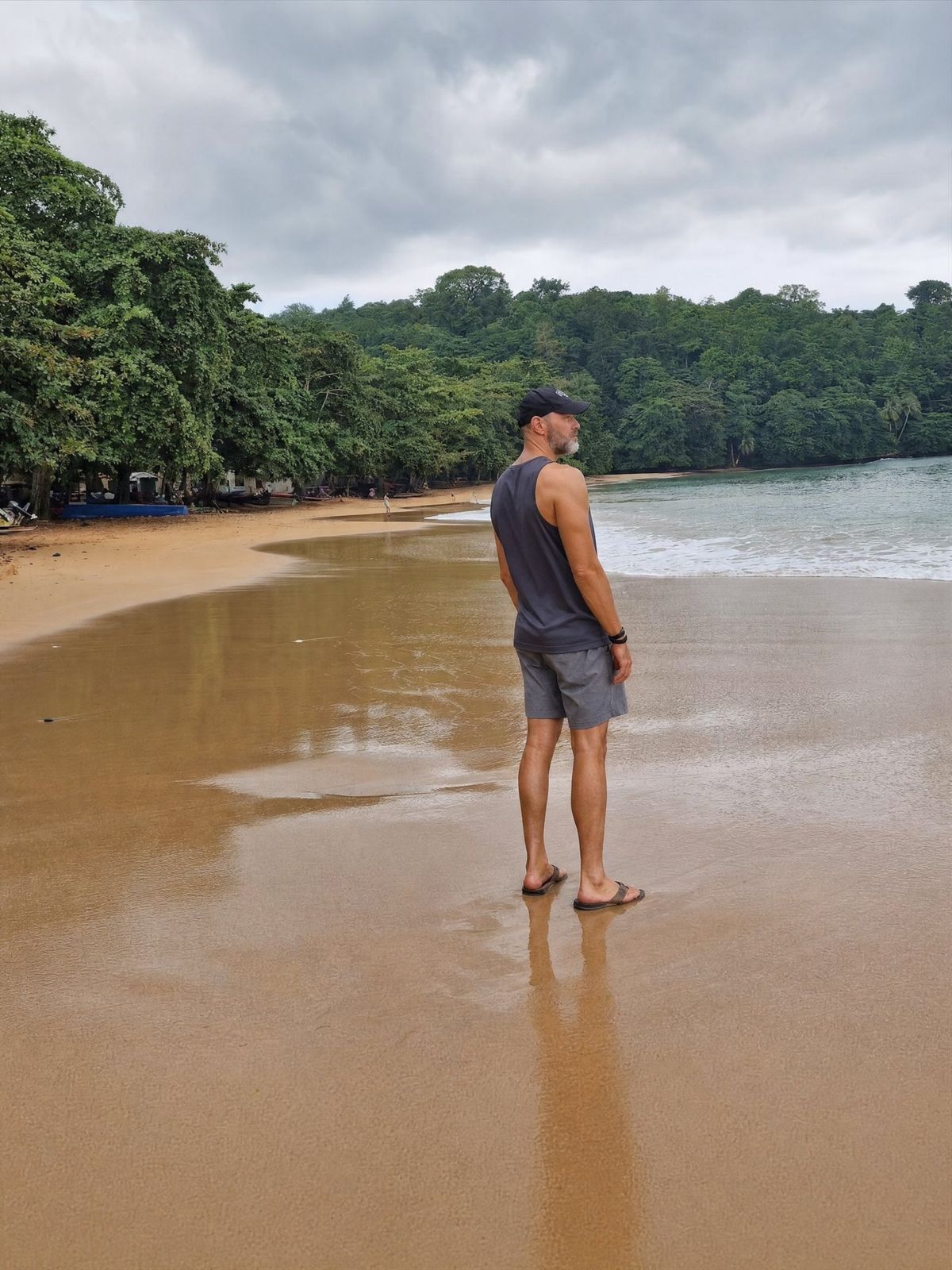
The flight from São Tomé to Príncipe is short, but it already feels like you are travelling somewhere much more remote.
Príncipe is small, green and mountainous, with dense vegetation covering much of the island. There is very little traffic, only a handful of settlements and almost none of the feeling that normally comes with arriving somewhere built around tourism.
We stayed at Quinta Santa Rita and explored the island with our guide, Miro.
That was a good decision. Distances on Príncipe are not huge, but transport options are limited and many of the places worth seeing are easier to reach with someone who knows the island well.
Our days took us across viewpoints, beaches and old plantation roads. We stopped at Antennas, Banana Beach, Mount Daniel and Burra Beach, where we had most of the place to ourselves.
One thing that kept standing out was how cared-for the island looked. Even around very simple homes, the grass was neatly trimmed, paths were clean and there was remarkably little litter. Príncipe often felt modest, but rarely neglected.
And then there were the dogs.
Príncipe seemed to have its own unofficial dog breed: a strange but lovable mix between a golden retriever and Dobby the house-elf. They were everywhere.
Food was simple and local. One of the meals I remember was sailfish with rice and fried breadfruit.
At Roça Sundy, the island’s colonial history becomes more visible. The old plantation structures remain part of the landscape, while cacao and chocolate are still closely associated with the island today.
We also spent a day exploring part of Príncipe by boat. From the water, the island looks even more isolated, with forested slopes dropping towards the sea and occasional fishing settlements tucked along the coast.
The weather was not always on our side. We had quite a bit of rain, and on one planned walk towards Pipi Waterfall the trail became muddy enough that we eventually turned around.
Partway through our stay, Miro became ill and Zezé took over as our guide.
Zezé was a teacher, and driving around Príncipe with him sometimes felt like travelling with the island’s unofficial mayor. He seemed to know everyone.
With him we visited Porto Real, where the remains of the old hospital are still standing. Zezé told us that he had actually been born there.
What to us looked like an abandoned building was part of someone else’s own history.
Príncipe can also be experienced in a completely different way. The island has several genuinely high-end hotels and resorts in spectacular locations, so it does not have to be a rough or basic destination at all. The prices, however, are firmly in the luxury category.
For us, the appeal was the quietness, the small scale and the feeling of being slightly disconnected from everything else.
Back on São Tomé
When we flew back from Príncipe, São Tomé suddenly felt lively.
After the quiet roads and empty beaches of the smaller island, there were more cars, more people, more noise and more everyday activity.
The capital itself is compact and easy to explore. We visited the cathedral and the market, and the city gave us a much more direct sense of daily life than the museum had on our first morning.
From there, the island quickly opens up.
One of the places where São Tomé’s history becomes especially tangible is Roça Água Izé.
Unlike some abandoned plantation sites, Água Izé is still very much alive. The old estate buildings have gradually become part of a small town. Structures that once served the plantation, including workers’ housing and storage buildings, are now woven into everyday life.
You are not walking through a frozen piece of colonial history. Children play between the buildings, laundry hangs outside homes and the old roça functions as a living community.
From there, we continued along the coast to Boca do Inferno.
I could have stayed there for hours.
Waves kept crashing into the black volcanic rock, but no two moments looked exactly the same. Sometimes the water exploded upwards, sometimes it disappeared into the gaps between the rocks, only to burst out again somewhere else a second later.
It was strangely mesmerizing. You kept waiting for the next wave, and somehow it never became repetitive.
If I lived on São Tomé, I think this is where I would come whenever I needed to clear my head.
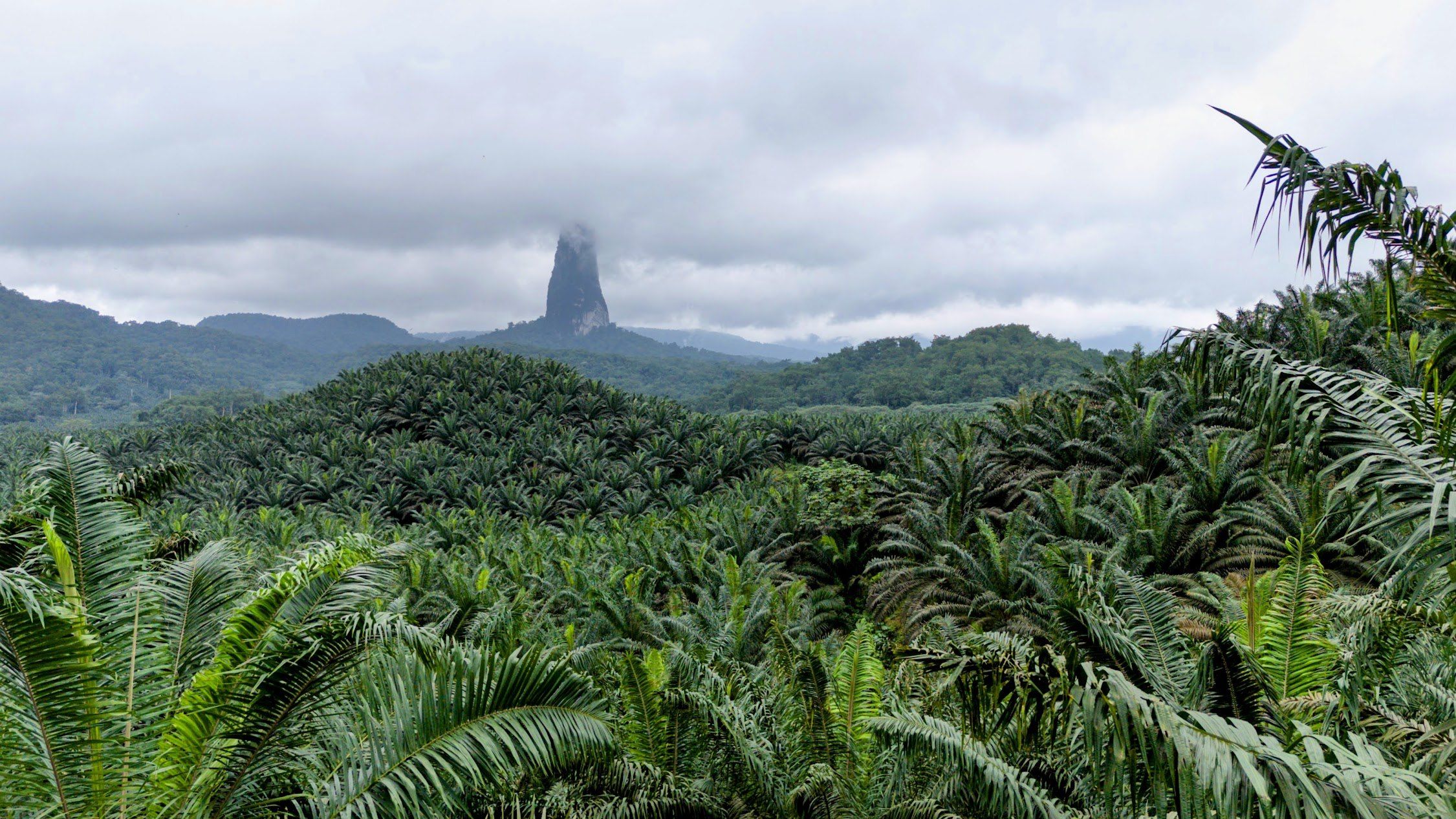
A last-minute hike to Pico Cão Grande
Further south, we drove to a viewpoint overlooking Pico Cão Grande.
I had hoped to fly the drone around the peak from there, but it quickly became obvious that we were simply too far away.
So I asked if there was any way to hike closer.
There was.
It turned into a much tougher walk than I had expected. The terrain was difficult, the heat was oppressive, and once we entered the forest we barely saw the peak at all.
Most of the hike was simply about pushing through the jungle and watching where we put our feet.
But when we finally reached the base, the effort paid off.
I managed to fly the drone from there, and the result was one of the most beautiful shots I have ever taken.
South to Ilhéu das Rolas
One of the main reasons to head all the way south is Ilhéu das Rolas.
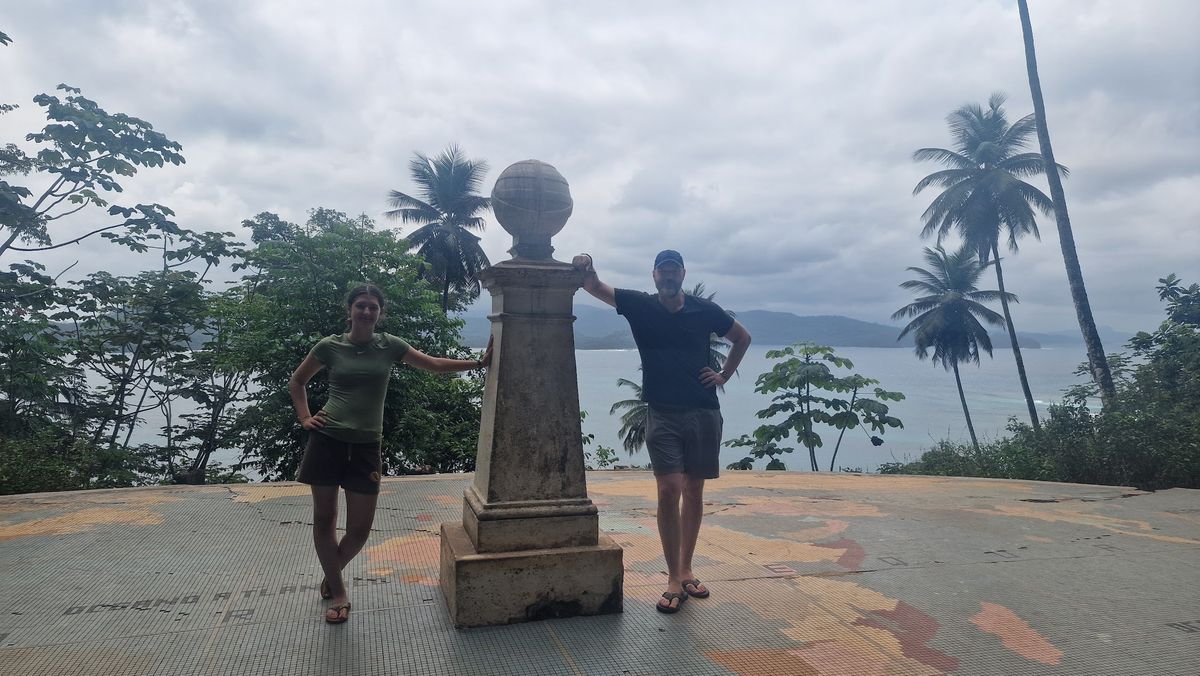
The small island lies just off the southern tip of São Tomé and is best known for its equator marker.
Getting there already feels like a small journey of its own. You leave the main island behind, cross the water and arrive somewhere compact enough to explore on foot.
Of course, we went to the equator marker. Standing with one foot in each hemisphere is simply too obvious an opportunity to ignore.
But the island itself is more than a geographical checkbox. It is green, quiet and surrounded by the ocean, adding yet another landscape to a trip that already moved between city streets, plantations, jungle, volcanic rock and beaches.
One last surf lesson
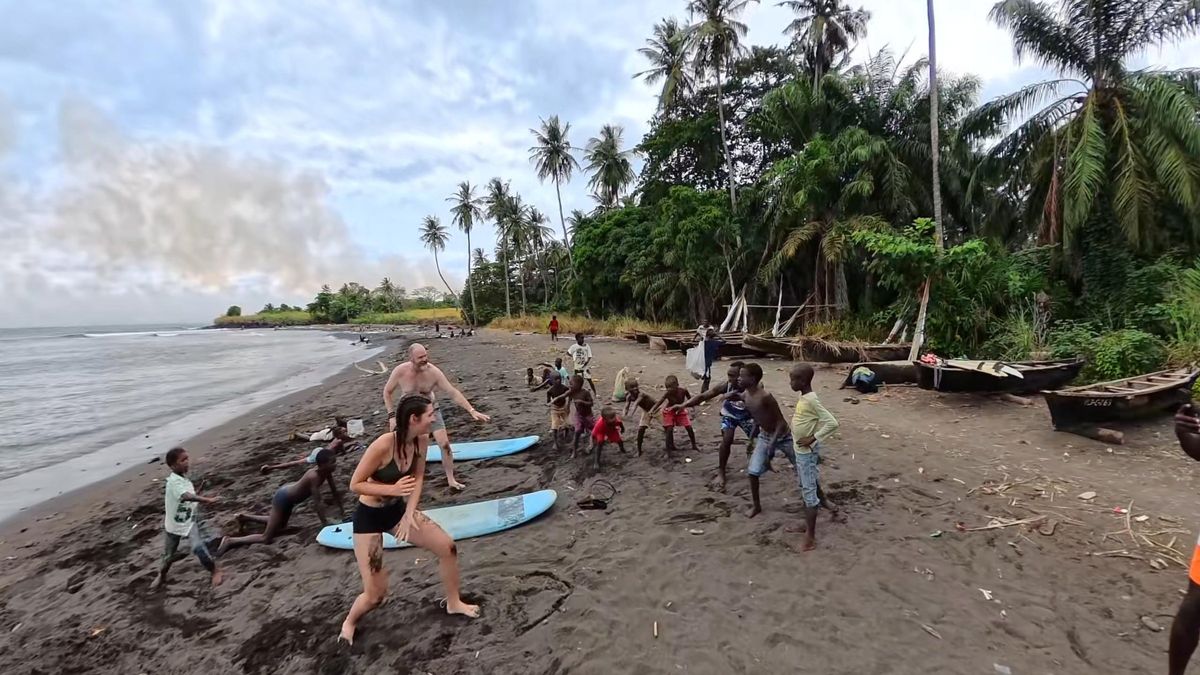
Our flight home was later that day, but we still had time for one final activity: a surf lesson.
I had every intention of standing up on the board.
In practice, I spent most of the lesson flat on my stomach, which my nipples apparently did not appreciate. I only discovered that properly afterwards.
It was still a fun way to end the trip, although the flight home was slightly less comfortable than expected.
Best time to visit São Tomé & Príncipe
For hiking and exploring, the official tourism board points to June through September as the drier Gravana season, when trails are generally more accessible. December through February is another useful window for beaches and clearer seas. Tropical weather is never completely predictable, though, and our own trip was a reminder that rain can still affect hikes and boat trips.
What we would do differently
A little Portuguese goes a long way. English is fairly limited across the country, and even more so on Príncipe. You can get by without speaking Portuguese, but knowing a few basic words and phrases would have made everyday interactions noticeably easier.
Timing matters too. We were not particularly lucky with the weather and had more rain than we had hoped for, especially on Príncipe. It did not ruin the trip, but it affected a few plans and made some hikes and excursions less straightforward than they would have been in drier conditions.
The other change would be our choice of accommodation on São Tomé.
We stayed in the same B&B on the north-eastern side of the island throughout our stay. It was a great place, and the island is small enough that you can drive south for the main sights and return the same day.
In hindsight, though, we would have spent at least one night further south. We ended up driving much of the eastern side of the island up and down twice, while the west coast remained largely unexplored.
São Tomé may not be a large island, but using two bases would have made the journey more varied and given us time to see another side of it.
Two islands, one journey
São Tomé & Príncipe never felt like one single destination.
There was the quiet, carefully maintained feel of Príncipe, with its small roads, beaches and sense of isolation.
And there was São Tomé, with more movement, more history in plain sight, rougher coastal landscapes and a much wider variety of places to explore.
In a single week, we visited old plantation settlements, stood at the equator, crossed tropical forest, watched the Atlantic explode against black volcanic rock and hiked through oppressive heat simply because I wanted to get a drone closer to a mountain.
Not everything went according to plan, and there are parts of the route we would organise differently next time.
As a compact journey through two very different islands, São Tomé & Príncipe gave us far more variety than its size suggests.
One of the things we appreciated most was how little tourism seemed to dominate everyday life. People were helpful, curious and often genuinely pleased that we had come, without every interaction feeling like it had to lead to a sale or some kind of transaction. It gave the islands a remarkably uncommercial feel.