
The island we kept returning to
São Tomé was the island we kept returning to.
We landed there first, spent our first night in the capital, flew to Príncipe for a few days and then came back to explore the main island properly.
That second arrival felt different. After Príncipe, São Tomé seemed suddenly busier, louder and more alive — not hectic by any international standard, but clearly the centre of gravity of the country.
It was also where the journey became much more varied: city streets, old plantation settlements, dramatic coastline, dense rainforest, volcanic rock and, eventually, one of the toughest hikes of the trip.
A first lesson in the country’s history
We had already had our first introduction to São Tomé before flying to Príncipe.
The morning after arriving, we visited the National Museum, which turned out to be a very good place to start. It gave us the broader historical context of the islands, from the colonial period to independence and the more recent political violence that had shaped the country.
That changed the way we looked at several places later in the trip. The roças, old administrative buildings and plantation settlements stopped being merely atmospheric relics and became part of a much larger story.
After that first glimpse of São Tomé, we left again for Príncipe.
A few days later, we returned.
São Tomé city
São Tomé city is compact enough to explore without feeling overwhelming, but lively enough to make it clear that this is the country’s main urban centre.
We wandered through the centre, passed the cathedral and spent time around the market, where daily life felt much more immediate than it had inside the museum. Shops, traffic, stalls and people filled the streets, and the city had a completely different energy from the quieter places we had just left behind.
We also ate at Papa Figo, which became one of those familiar names during our stay.
The capital never felt like a destination that needed days of sightseeing, but it worked well as an introduction to the island and as a base between excursions.
From there, the road south quickly changed the character of the trip.
Roça Água Izé: history that is still inhabited
One of the places where São Tomé’s past feels especially tangible is Roça Água Izé.
The former plantation is not an abandoned ruin. It is still inhabited, and the old estate buildings have gradually become part of a living settlement.
Structures that once served as workers’ housing, storage spaces and other plantation buildings are now woven into everyday life. Children play between them, laundry hangs outside homes and the old roça functions as a small town.
That creates a very different atmosphere from walking around a preserved historical site. The colonial layout is still visible, but daily life has simply grown into it.
Some of the old buildings still carry a sense of their former scale and ambition, but the tropical climate is steadily reclaiming them. Walls crack, roofs weaken and vegetation pushes into places that were once carefully maintained.
There is a particular beauty in that kind of faded grandeur: once-majestic buildings gradually losing an unavoidable battle against time, moisture and the all-consuming vegetation.
Boca do Inferno
From Água Izé, we continued along the coast to Boca do Inferno.
This was one of the places I could have stayed much longer than we did.
Atlantic waves crash into the black volcanic rock, disappearing into narrow openings before bursting upwards again in different shapes and directions. Every wave creates something slightly different from the one before it, which made the whole place completely mesmerizing.
You could stand there for a very long time, waiting for the next wave and never quite seeing the same thing twice. If I lived on São Tomé, I think this is where I would go whenever I needed to clear my head.
Praia Pesqueira Waterfall
Along the road south, we stopped at Praia Pesqueira Waterfall, where the river drops over a low rocky ledge just before meeting the Atlantic. From above, the whole scene made much more sense: waterfall, river and ocean all connected in one compact landscape.
Pico Cão Grande
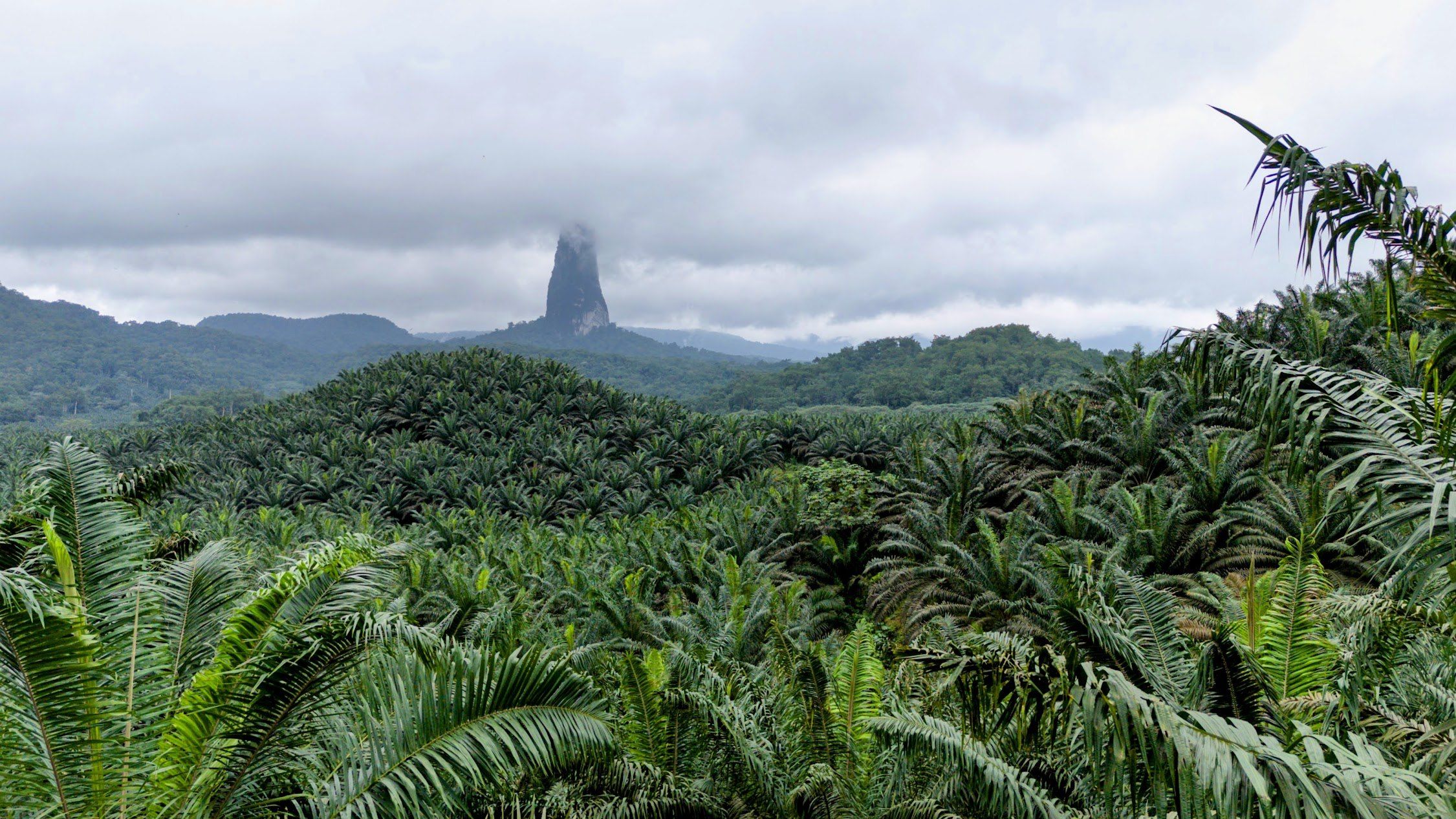
Farther south, the landscape becomes increasingly dramatic, dominated by Pico Cão Grande, arguably the most recognisable landmark on São Tomé. Its name literally means “Big Dog Peak”, although the narrow volcanic tower rising almost vertically from the rainforest looks unlike anything its name might suggest.
We had driven to a viewpoint because I hoped to fly the drone around it, but once we arrived it became obvious that we were much too far away to capture the kind of footage I had in mind. I asked our guide whether there was any way to get closer on foot, which immediately set off a small series of phone calls as he tried to find someone who could take us through the forest to the base.
After a few minutes, we got the good news: he had found a local guide willing to take us.
The walk was considerably tougher than I had expected. The terrain was difficult, the heat was oppressive and, once we entered the dense vegetation, we barely saw Pico Cão Grande at all. Most of the hike was spent concentrating on where to put our feet and pushing through the humid forest rather than admiring the scenery.
Eventually we reached the base, where I could finally launch the drone close enough to capture the perspective I had hoped for. The resulting footage became some of the most rewarding shots I have ever taken, and I did the entire hike back with a huge smile on my face.
Staying in one place was convenient — but not ideal
Throughout our time on São Tomé, we stayed in the same B&B on the north-eastern side of the island.
It was a great place to stay, and because São Tomé is relatively small, the distances make it perfectly possible to drive south for the day and return in the evening.
In hindsight, though, we would have organised that differently.
We ended up travelling along much of the eastern side of the island more than once. Staying at least one night farther south would have reduced some of that repeated driving and, more importantly, would probably have given us the opportunity to explore more of the west coast.
The island may look compact on a map, but using two bases would have made the route more varied.
Ilhéu das Rolas
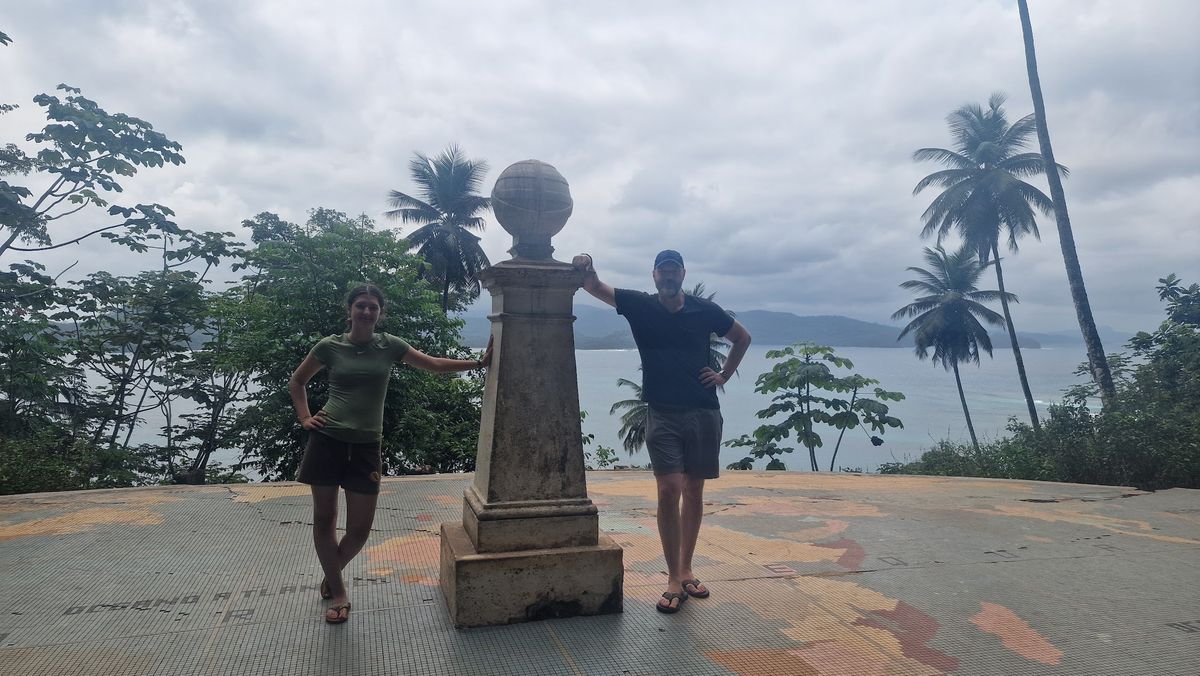
One of the main reasons to continue all the way south is Ilhéu das Rolas, the small island just off São Tomé’s southern tip.
Getting there already feels like a small excursion in itself. You leave the main island, cross the water and arrive somewhere small enough to explore on foot.
Naturally, we went to the equator marker and stood with one foot in each hemisphere. At least, that’s what they make us believe. 😉
The island itself was green, quiet and surrounded by the Atlantic, adding another distinct landscape to a trip that had already included city streets, plantations, jungle and volcanic coastline.
One final activity before the flight home
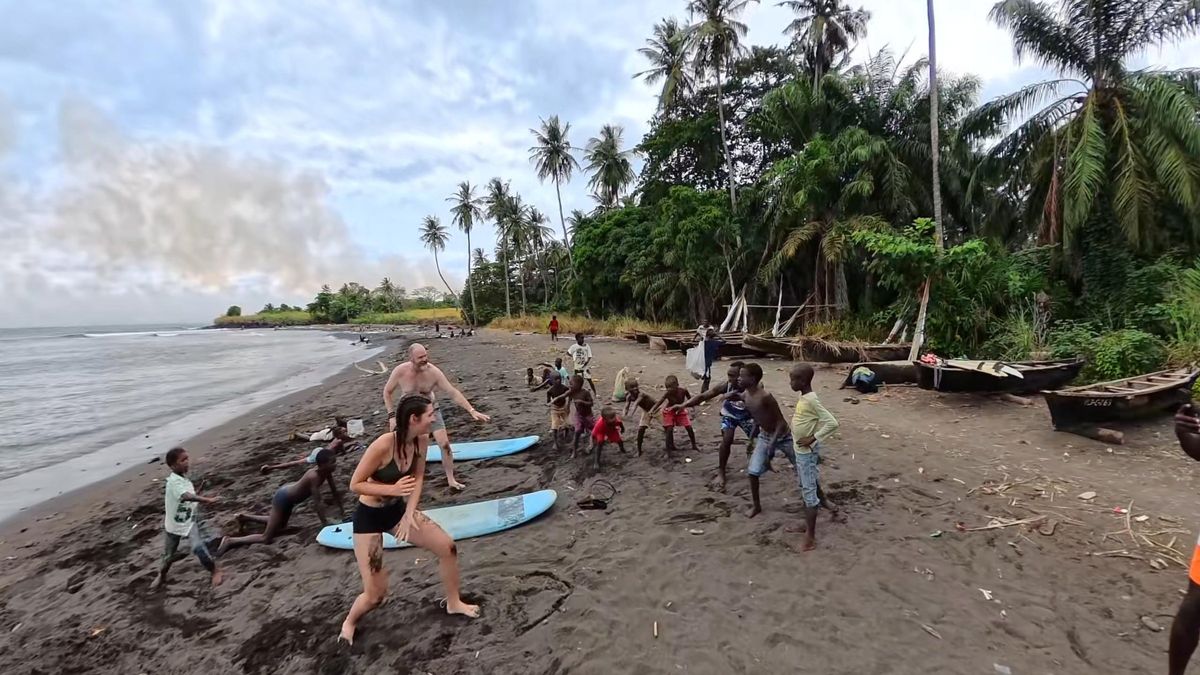
Our final day on São Tomé ended with a surf lesson.
We were flying home later that day, but there was still enough time to get into the water once more.
I had every intention of standing up on the board. In practice, I spent most of the lesson flat on my stomach, which turned out not to be particularly kind to my nipples.
Regardless, it was still the perfect way to end the trip.
The São Tomé we remember
São Tomé gave us a very different type of experience from a classic tropical island holiday.
There were beaches and warm water, but they never defined the trip. What stayed with us was the variety: the National Museum giving us context for everything that followed, Água Izé showing how colonial history still lives inside modern communities, Boca do Inferno turning the Atlantic into something almost hypnotic, and Pico Cão Grande transforming a failed drone plan into a difficult hike and some of my most rewarding footage from the entire journey.
Ilhéu das Rolas added one final island excursion, while the surf lesson gave us a fittingly imperfect ending.
If we returned, we would change the route and spend at least one night farther south so we could explore more of the western side of the island. But as an introduction to São Tomé, the eastern and southern parts gave us an extraordinary amount of variety in only a few days.
Practical tips for visiting São Tomé
- History
- The National Museum is a useful first stop because it gives context to the roças and other colonial-era sites around the island.
- Route planning
- Staying in two different parts of São Tomé would make it easier to explore both the east and west coasts without repeating the same drives.
- Pico Cão Grande
- Reaching the base involved a difficult, hot hike through dense vegetation; arranging a local guide was essential for us.
- Ilhéu das Rolas
- Easy to combine with a trip to the south of the island.